
 I have loved mushrooms since childhood, and I have also been a programmer for a long time. Combining these two hobbies, I wrote this website. Previously, I had two other mushroom identification sites, which I sold. Only one of them remains accessible today. My goal with the current site is to create an easy-to-use search and identification platform that works great both in the field and at home. I hope it brings joy to others.
Bartha László
Species flashcards
Practice area: created for the 303-species Hungarian mushroom inspector requirement. It is not an official examination; requirements in other countries may differ.

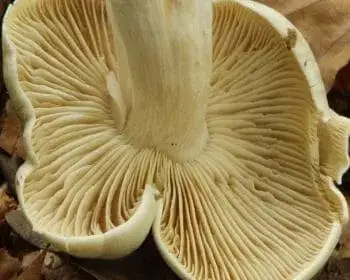
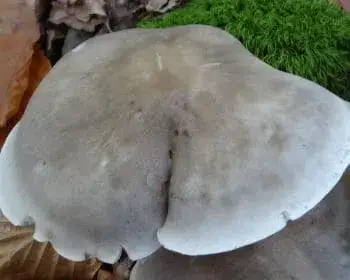
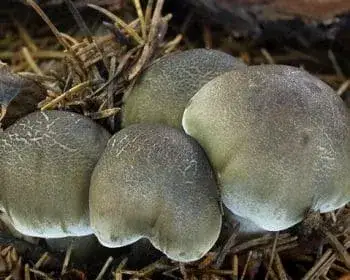
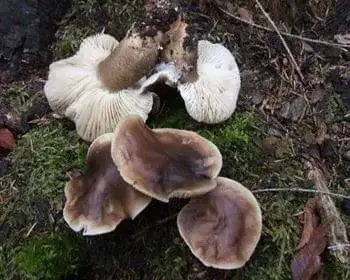
Soapy Tricholoma
Tricholoma saponaceum
poisonous
- Habitat: deciduous
- Fruiting season: August – December
- Cap: flat conical umbonate smooth infolded
- Stem: tapering ventricose rooting
- Fertile layer: adnate smooth
Description
Cap: The cap is about 8-10 cm wide. Initially convex, then slowly flattens, its margin remains infolded for a long time, finally becoming irregularly lobed. The color of the cap skin causes many problems for collectors; greenish-yellowish, brownish, brownish-gray, blackish, whitish, with a slightly reddish tone and many intermediate shades.
Gills: The gills are quite sparse, curved-adnate to the stem. Whitish or pale yellowish-gray, often with reddish spots.
Stem: The variously shaped (ventricose, curved, cylindrical or straight) stem is 10 cm tall and 1.3-3 cm thick. Its color is roughly similar to the cap, but often paler. Its surface is sometimes decorated with a fine, black scaly layer, but completely smooth specimens can also be found.
Flesh: The white flesh slightly reddens on the cut surface. It has a well-perceptible musty, "laundry soap" smell. Its taste is mild or sweetish, but often also bitter.
Spore: White; 5.5-7 x 3.5-4.5 µm; almost spherical, smooth.
Occurrence: In Hungary, a common species in acidic deciduous and coniferous forests, from August to November. Usually found in groups.
Edibility: Inedible due to its unpleasant smell and taste.
Confusion: As the description shows, this species is very variable, and many of its varieties have been described. The mushroom has already fooled many collectors.
Note: saponaceum means soapy-smelling.
Species description: It was scientifically described in 1801 by Christiaan Hendrik Persoon. The genus name was given in 1818 by the Swedish mycologist Elias Magnus Fries, so it is recorded as Tricholoma saponaceus. The meaning of the genus name - I have described it for several species - it is worth knowing that it is less apt, as there are few species whose cap margin has hairs or fibers hanging from it.
Taxonomy
- PhylumBasidiomycota
- ClassAgaricomycetes
- OrderAgaricales
- FamilyTricholomataceae
- GenusTricholoma
- Species: saponaceum
- Described by: (Fr.) P. Kumm.
- Hungarian name: szappanszagú pereszke
- Lifestyle: mycorrhizal
- Edibility: not edible
