
 I have loved mushrooms since childhood, and I have also been a programmer for a long time. Combining these two hobbies, I wrote this website. Previously, I had two other mushroom identification sites, which I sold. Only one of them remains accessible today. My goal with the current site is to create an easy-to-use search and identification platform that works great both in the field and at home. I hope it brings joy to others.
Bartha László
Species flashcards
Practice area: created for the 303-species Hungarian mushroom inspector requirement. It is not an official examination; requirements in other countries may differ.

Spiny Dapperling
Echinoderma aspera
not edible
- Habitat: deciduous coniferous
- Fruiting season: June – October
- Cap: flat conical bell spotted
- Stem: cylindrical thickening
- Fertile layer: free dense forked fringed
Description
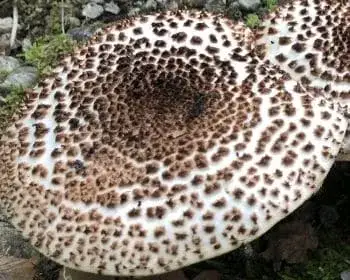
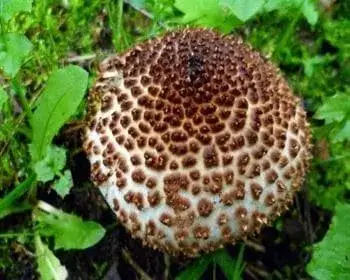
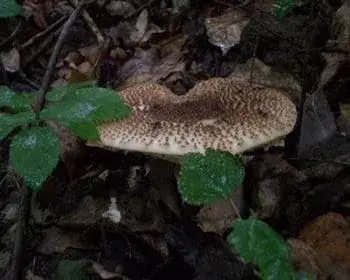
Cap: Conical or bell-shaped when young, later flattening. Its width can reach 12 (15) cm, its rust-clay-brown surface is covered with striking, yellowish-brown to dark brown, conical or pointed scales.
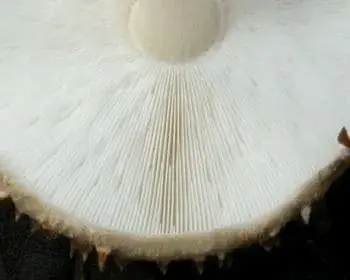
Gills: Free, white, often forked, quite narrow and densely standing; their edges irregularly, finely notched.
Stem: Whitish, maximum 12 cm tall and 1-2 cm thick. Below the hanging, membranous ring, the stem is covered with scales similar in color to those on the cap. Its cylindrical lower part may be slightly thickened.
Flesh: White, its smell and taste are very unpleasant.
Spore: White; 6.5-11 x 2-3.5 µm; elongated ellipsoid, smooth.
Occurrence: Occurs in both coniferous and deciduous forests, prefers dense leaf litter; also found on roadsides, parks and scrublands. Widespread everywhere, common in Hungary, from June to October.
Edibility: Due to its repulsive smell and taste, the spiny dapperling is completely inedible.
Confusion: There are about 11 lepiota species with pointed, spiny-scaly caps, but most of them are generally small and very rare. They grow especially in damp forests and parks. Their identification is difficult and requires a lot of experience, usually requiring the use of literature and a microscope.
Note: Mycological experts currently classify about 50 species in the lepiota genus, some of which are severely poisonous. The scientific name "aspera" means rough, uneven.
Species description: Lepiota aspera (Pers.) Quél. 1886
Taxonomy
- PhylumBasidiomycota
- ClassAgaricomycetes
- OrderAgaricales
- FamilyAgaricaceae
- GenusEchinoderma
- Species: aspera
- Described by: (Pers.: Fr.) Bon (1991)
- Hungarian name: tüskés őzlábgomba
- Lifestyle: soil saprotroph
- Edibility: not edible
