
 I have loved mushrooms since childhood, and I have also been a programmer for a long time. Combining these two hobbies, I wrote this website. Previously, I had two other mushroom identification sites, which I sold. Only one of them remains accessible today. My goal with the current site is to create an easy-to-use search and identification platform that works great both in the field and at home. I hope it brings joy to others.
Bartha László
Species flashcards
Practice area: created for the 303-species Hungarian mushroom inspector requirement. It is not an official examination; requirements in other countries may differ.

Royal Bolete
Boletus regius
edible marketable
- Habitat: deciduous
- Fruiting season: June – October
- Cap: hemispherical flat smooth fibrous
- Stem: ventricose club-shaped
- Fertile layer: free narrow
Description
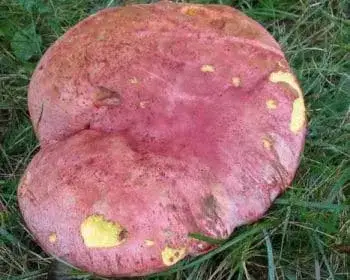
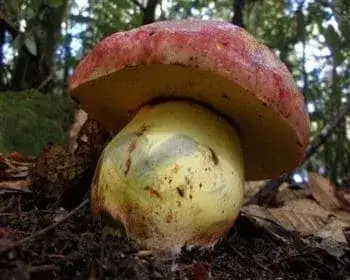
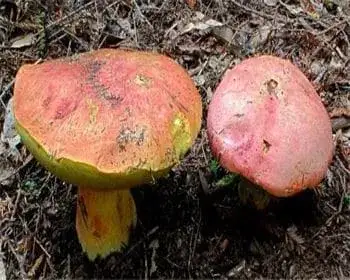
Cap: Convex, thick-fleshed, 8-20 cm wide. Color can be various shades of reddish-pinkish, mostly pinkish, but can be yellowish-, bright red, purplish- or sometimes brick-red, brownish-red. Its surface is finely fibrous.
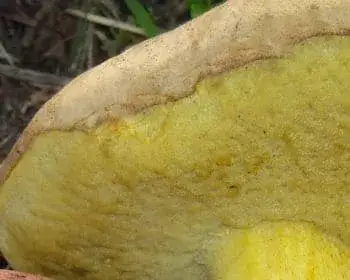
Tube layer: Bright yellow or lemon yellow, narrow-pored. On pressure or injury, it gets a greenish-blue spot. Spore print brownish-yellow.
Stem: Mostly swollen at the base, club-shaped, ventricose. Base color bright yellow, but often patterned with red. Especially at the base, it may possibly be slightly blood-red.
Flesh: Firm. Bright egg-yellow. Insect damage inside usually discolors to brownish-red. When broken, it usually reddens, possibly slightly blues. At the stem base, the flesh may be cherry- or blood-red.
Spore: Olive-brown; 10.5-16 x 3-5μm; narrowly elliptical, spindle-like, smooth and transparent.
Occurrence: In deciduous forests, mainly in oak and beech forests, on rocky soil. Only scattered, but locally in masses. Rather a summer, early autumn, mycorrhizal mushroom.
Edibility: Pleasantly sourish taste. Excellent edible mushroom, just like the king bolete. Can be used in all ways, and always good-tasting. Also excellent for drying.
Confusion: A characteristic mushroom, any confusion with the poisonous lurid bolete, the bitter bolete and Satan's bolete can be easily avoided. The royal bolete's cap is red, while those have mainly their stem or the hymenium under the cap. Most similar to it is the non-poisonous purple bolete, because its cap is also pinkish, and its hymenium can also be yellow when young, but its tube layer later becomes purple-red or brick-red, and its stem is also mostly bright red. Among the edible species, it is perhaps somewhat similar to the ochre bolete, but its cap is not pinkish, but reddish-brown.
Note: The Boletus name comes from the Greek word Bolos - lump of clay, or marble. The Hungarian name "tinóru" comes from its resemblance to a bull's nose. reguis is Latin for king, royalty.
Species description: In 1832, the Czech Julius Vincenz von Krombholz (1782-1843) mycologist first described the royal bolete, naming it Boletus regius, a name still valid today.
Taxonomy
- PhylumBasidiomycota
- ClassAgaricomycetes
- OrderBoletales
- FamilyBoletaceae
- GenusButyriboletus
- Species: reguis
- Described by: (Krombh.) D.Arora & J.L.Frank (2014)
- Hungarian name: királytinórú
- Lifestyle: mycorrhizal
- Edibility: edible
